


The PROMINENT project will improve, streamline, and facilitate the procedure of structural design and structures’ health monitoring by designing a software tool PAK-DAM with the possibility of integration into BIM and Digital Twins systems for prediction of damage initiation and evolution in engineering structures and by experimental investigation of materials to identify material parameters, to calibrate constitutive models, and to test and verify software functionality and accuracy. It will also increase the visibility of the PROMINENT team.
The specific objectives (SOs) of the PROMINENT project and expected results (R) are:
- SO1: To develop and improve 6 algorithms necessary for implementation of PFM for metals (brittle and ductile) and for concrete;
- This objective will be achieved by preparation of a document containing theory background, details related to the evolution of equations, and implementation algorithms divided into the steps. The algorithms will be optimized to provide better convergence. The new two-intervals hardening function will be used, as well as the modified PFM at finite strains.
- R1: 1 document “Theory manual for PAK-DAM software tool”
- SO2: To identify material parameters and fracture toughness of the concrete and metal (steel and aluminum) by experimental testing
- This objective will be achieved through the static and dynamic experimental testing by capturing the response of the set of investigated metal and concrete specimens.
- R2: 1 document - “On the experimental testing and identification of material parameters for metal and concrete specimens”
- R3: 400 investigated specimens = 50 specimens × 8 experimental programs
- SO3: To develop PAK-DAM finite element method simulation tool for the damage assessment;
- This objective will be achieved through the preparation of the source code FORTRAN files according to the proposed PFM algorithms for concrete and metals to allow a damage assessment of the engineering structures.
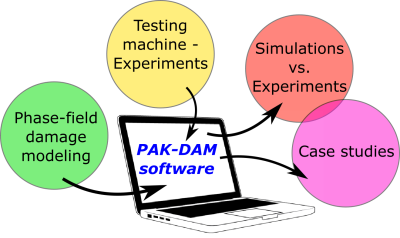
- R4: 1x PAK-DAM software tool in executable format (exe file) + source code in FORTRAN language
- R5: 1 document - “User manual for PAK-DAM software tool”
- SO4: To verify the developed PAK-DAM tool and to apply it to engineering structure case studies;
- This objective will be achieved through comparison of experimental testing and numerical simulation results. FEM examples will be prepared to simulate and the results will be compared to the examples collected from the representative literature (e.g. shear loading) and the conducted experimental tests using the identified material parameters and the same loading and boundary conditions as in the experimental tests. Final verification will consider a real metal and a real concrete structure to demonstrate the functionality of the PAK-DAM tool interpreted with respect to safety of structures.
- R6: 1 document - “Example manual for PAK-DAM software tool”
- SO5: To increase the visibility of the PAK-DAM software tool and the project team excellence;
- This objective will be achieved through a wide range of dissemination and promotional activities which are foreseen in order to increase visibility of the PAK-DAM software tool, the PROMINENT team members and the project outcomes.
- R7: 10 articles in top scientific journals - Rank Q1 and Q2 according to JCR, and 9 international conference presentations and papers,
- R8: 1 technical solution at international level registered by Ministry of Education, Science and Technological development

